
“Farming is not just a job, it’s a way of life.” – Unknown
For most people, Labor Day is a holiday when you don’t have to work. You have the day off. You can go on a picnic, go fishing, read a book, visit family, have some fun. That might be true for me now, but that wasn’t always the case when I was a kid or even later after marrying.
My father was a farmer. When I was a kid, he had beef cows, grew corn, cut hay, and raised tobacco. Most every farmer raised tobacco as his cash crop back in the 1900’s. The government had a program where they assigned every farm a tobacco allotment. According to the amount of acres you owned, you got the right to grow a set number of acres of tobacco. A small farm might be allotted a partial acreage amount.
Dad had an allotment of several acres. I don’t know how many. Maybe three. Maybe five. All I remember is I thought it was a lot. And then when I was a teenager he partnered with another man and rented other acres on other farms where the farm owner didn’t want to or couldn’t for this or that reason do the work of growing the tobacco. So Dad and his partner would raise the tobacco on the farms that had the allotment, do all the work, take it to market and split the amount of whatever the tobacco brought with the farmowner.
He wasn’t a tenant farmer. My husband’s father was. He lived on the farms in a tenant house and milked cows and raised the crops for half the income. He needed the tobacco crop to bring in that extra cash. For many farmers, the tobacco that generally was sold late in the fall or early winter and helped many farm families have Christmas presents under their Christmas trees. Farmers like my dad also needed the tobacco income to pay the property taxes on their farms as well as salt some away for rainy days on down the road.
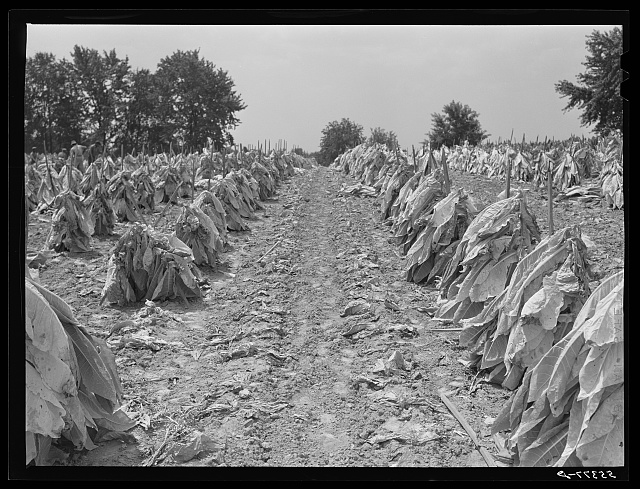
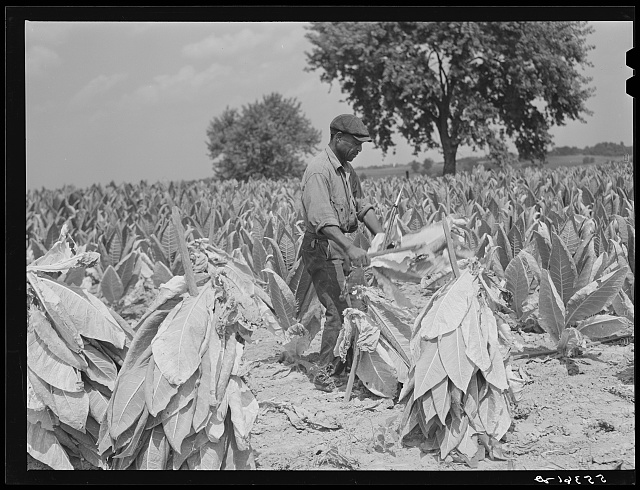
Labor Day weekend came at harvest time for tobacco. My sisters and I were right out there in the field helping. I never cut the tobacco – that is, chop it down with a special tobacco knife that looked something like a light hatchet and then spear the stalk on a tobacco stick. I did have to drop those sticks down the rows of tobacco so the cutters would have them in front of them to grab and jab in the ground to spear on five or six stalks. Then I helped hand those sticks of tobacco up to whoever was loading the wagon.
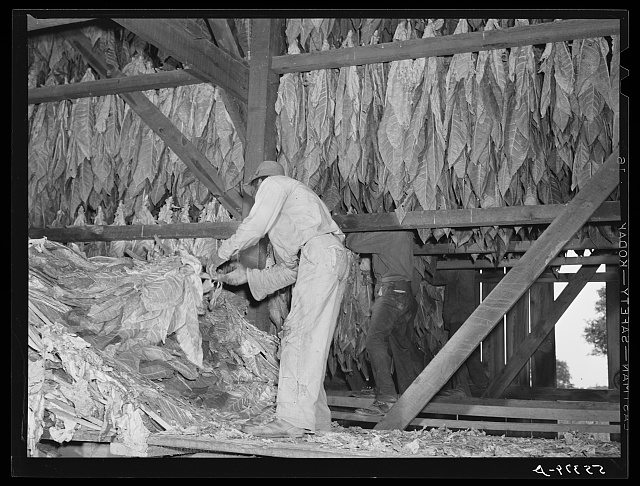
We got to rest on the ride to the barn once the wagon was loaded. Of course, that wasn’t very far from the field. Then I usually either handed the tobacco sticks off the wagon to someone on the ground who handed it up to whoever was on the first rail. Most tobacco barns had several rails. The tobacco was handed up to whoever was in the top rails, then the next rail, and last the man on the bottom rail hung a stick. Then the men (usually men but sometimes a woman would climb up in the barn) would scoot a little back on the rail and start the process over until those rails were filled. Then they would climb over into the next set of rails until the barn was full.
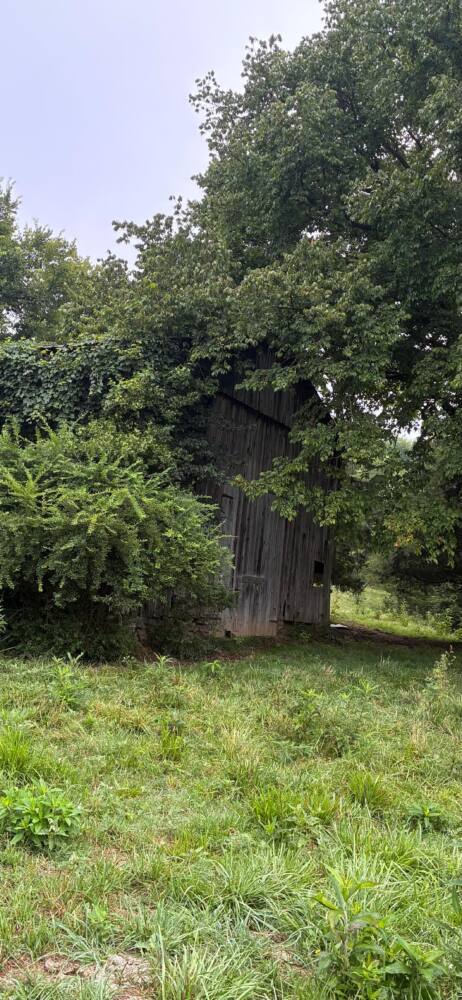
This barn in the picture wasn’t like our barns. Ours had rails coming out toward the wagon. Then there were rails up over the wagon in the middle of the barn too.
My husband raised tobacco too for many years after we married until the government stopped the tobacco allotment and price support programs and small farms gave up on tobacco crops. I don’t have pictures of our tobacco harvesting days. That would have felt like a waste of film and photo developing money. No digital cameras like today where you can take a zillion pictures of everything. But the Library of Congress has pictures of the tobacco growing years here in Kentucky. The top pictures are from their files.
What I remember most about helping my dad in tobacco was that the rows seemed a mile long when I was dropping those sticks between the tall stalks of tobacco. The leaves were gummy. It was hot, dirty work. And every holiday instead of going to the pool or the creek for a day of fun, a farmer and his daughters and sons (my dad didn’t have any of those) were right out there in the field working to make enough money to farm another year.
“The real mystery was how your farm bound you to it, so tightly that you would pay any price (literally, in interest) or make any sacrifice just to take these steps across this familiar undulating ground time and time again.” ― Early Warning
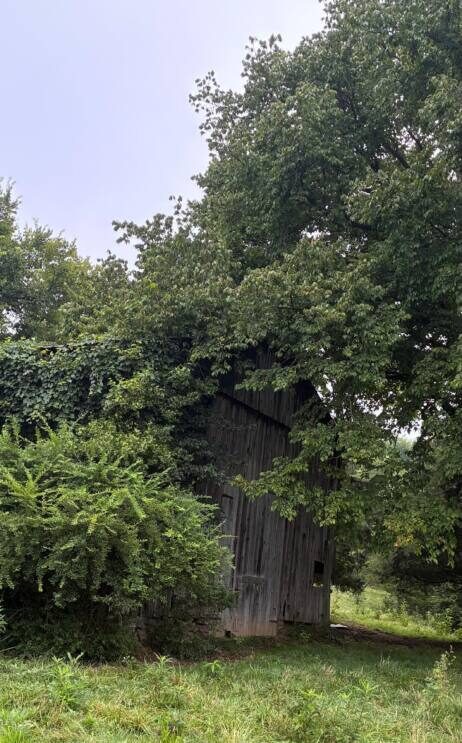
Here’s our old tobacco barn. The trees are pushing in on it now that it isn’t being used.
Did you ever work on a farm?
Before you go, if you didn’t see my recent newsletter, here’s a link to it. The deadline to enter the giveaway is Tuesday night, 09-08-2026, at midnight.
Comments 18
I never worked on a farm. I grew up in a small town. But my husband did and said it was hard, hot, work and the chemicals that were sprayed on the tobacco made him feel sick. I’m grateful I never had to work in a field but appreciate those who do. Especially for crops like corn, hay for the cows, and soybeans. I live in the country now and those are the main crops grown here. There’s lots of tobacco fields too. I’m amazed at how much the crops grow despite having little rain this year too. We’re in drought and in need of rain but the crops, thankfully, grow on.
No, I never worked on a farm, though both of my parents lived on farms when they were growing up!
Yes I have worked on a farm in tobacco and in our fresh homegrown produce I always enjoyed the outdoors and yes it is hard work ! Now as I Have gotten older and my health isn’t that good I no longer get to be outside working in the garden like I use too Thank you for the amazing giveaway
I worked in tobacco many years ago on grandpas farm in Owsley co KY . He hung tobacco in the top of the barn until he was 80 years old . I remember when it would come into “case”, it would then be gradually moved to an out building called the “stripping room” . There the the leaves would be stripped, sorted and tied into “hands” . After all the tobacco went thru this process it would be taken to the tobacco barn in Richmond to be sold. All of the farmers depended on tobacco for cash crop , shoes for winter could be purchased , a few items for Christmas etc. Hard work for sure but I am glad for these memories of good times with family on the farm.
Both sets of my grandparents were sharecroppers in NC where I live. They were able to buy quite a lot of land, which has now been passed on to family. I’m very proud to live on land which belonged to my grandparents. To answer the question, yes, I worked on the farm. My brothers and I worked in tobacco from the time we were around 6 years old though high school age. Our parents saved our money in our own bank accounts, which was later used for our first “used” car and college. Because of these experiences, we each grew up with a very strong work ethic.
Author
A strong work ethic is a great thing for young people to have, Susan. And having your own earned money to buy that first car instead of it being given to you gives a young person a true sense of the worth of earning money through work.
And getting to live on land that has been in the family is always something to treasure. Your grandparents must have been good savers to be able to sharecrop and then buy their own land.
When I married my husband I moved to eastern N.C. from western N.C. to where he lived at. He had been a tobacco farmer but was getting into another job when we got married. The new job just lasted a few years and I also was in-between jobs one summer when we both helped his brother in harvesting the tobacco. I was new to this. I lay the tobacco on sticks at the barn and it went through an automatic sewer that sewed the tobacco on the stick so it wouldn’t have to be hand looped. It was hot, sticky, gummy work, and sometimes the sewer didn’t work right and the tobacco fell off and we would have to do it all over again. I was glad when a new job for me came through working in an air conditioned office. Since then, harvesting tobacco has become mostly automated with little need for a lot of employees.
Author
That was way different from how we did tobacco here, Connie. No automation for Kentucky tobacco farmers then, and I don’t think so even now although you don’t see many fields of tobacco around here any more.
But a job in an air-conditioned office does sound better. 🙂
My dad was a minister, so we never farmed, but I picked cotton on the farms of church members! 😊
Author
You must have grown up down south, Vangie. No cotton growing here in Kentucky. When I was on a trip once, I was interested to see cotton growing in the fields we passed.
I have never worked on a farm. I entered the giveaway through your website. I didn’t receive your latest newsletter.
Author
I saw your email, Diana. I’ll check to be sure you’re still signed up to receive copies. Sometimes newsletter emails end up in Spam folders.
Growing up, I was blessed to be able to spend a notable amount of time on my maternal grandparents’ farm in Platte County, Missouri (just north of Kansas City). Although they were aging by then, they still raised a large garden, some crops, a couple of horses, a few pigs and cattle, and a chicken coup full of chickens (they sold a lot of eggs and milk). Without question, those were some of the best days of my life. I miss my grandparents and my “farm life” so much.
Author
A Missouri farm. Interesting, Chris, how farm raise such different crops in different regions. Even tobacco was raised differently to the south. But Kentucky farmers did raise a lot of burley tobacco. And many farmers milked cows. That too has changed a lot over the years.
I wasn’t a farm girl, although I wanted to be. But, after hearing about all the work you did, maybe I’m glad I wasn’t! 😬. I, too, remember school starting the day after Labor Day and I was always ready for it, since I loved school. And, reading has always been one of my favorite pastimes. Thank you for your contribution to that habit, Ann! ❤️
Author
Thank YOU for reading, Judi. I was always ready to go back to school in the fall too. Being out in the country on my farm didn’t give me must chance to see other girls excep, of course, my sisters.
I grew up on a dairy farm, with hay and tobacco, .We worked in tobacco for us, our grandpa’s farm and our neighbors crop , Nobody was done til everyone was done.
It was hot hard work, until stripping time, then it was freezing cold work, but I wouldn’t trade it for the world.We knew how to work . I think it made me a better person to be raised up knowing how to work hard. There was a lot of teamwork in it too.Our families were close, we worked together and played together.
My kids grew up in our tobacco patch and my dad’s tobacco patch also.
These days none of our family raises tobacco, but I’m glad of my roots.
Author
Most farmers quit raising tobacco after the buy-out years ago, Lisa. If I’m honest, I could have been happy with a little less tobacco work. LOL. I think I disliked the stripping tobacco part of raising tobacco. You couldn’t get that over with so quickly. Took days and days to get it done. Of course, payday did follow soon after.
I am glad I grew up on a farm in a farming community.