
 One thing almost all of us want to know each morning is what the weather is going to be like that day. Should we take a coat? Will I need an umbrella? Just how hot or how cold (according to the season) is it going to be? Will we be sweating or shivering?
Nowadays, we turn on the television or radio to get that forecast or perhaps, even more likely, we look at our phones to see what that wise little guy inside it has to say about the weather. It hasn’t always been this way with most of us having a computer, via our phones, in our hands or pockets. For some, it might be a watch on their wrist. My husband loves to look at the radar pictures to see how soon it is going to rain or stop raining or snowing.
We can be a little obsessed with the weather. Often as not, it’s the first thing we talk about to others we meet. How’s the weather? Think it might rain? Did you get much snow? What’s the weather forecast?
Long before we had phones or weather forecasters on television, people were still talking about the weather and trying to figure out what weather might be coming their way. They had different ways of coming up with forecasts. They checked the skies. They studied the clouds. They looked at the moon. They remembered what the weather was like before or what the old folks through the ages passed down to them about figuring out the weather. That combined experience made them come up with some interesting ways of knowing what weather was going to come their way.
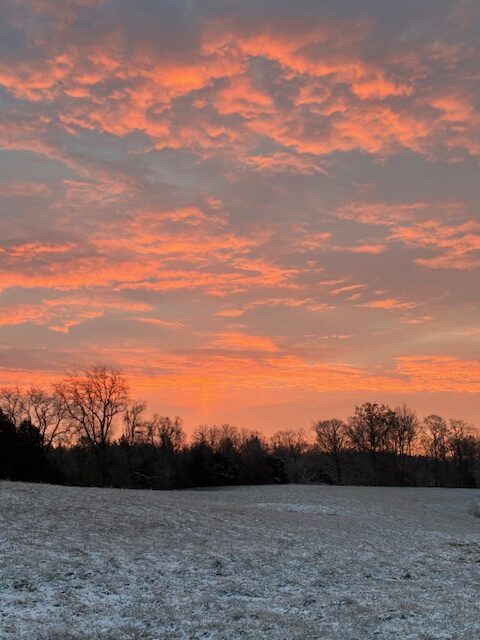
Red sky in the morning, sailors take warning. Red sky at night, sailor’s delight.
Most everyone has heard that old forecast. Often, it turns out to be right. The picture here was of the sky this morning. The day has seen a cold rain that might turn to snow.
A ring around the moon means it’s going to rain or snow.
Another thing that is often true because of how that halo is a sign of moisture in the air which can happen before an impending storm, especially during the winter. I seem to remember too that if there was a star or stars inside the ring, that meant it would be that many days before it rained or snowed. True or not, that makes for an interesting forecast.
Counting the time between a flash of lightning and the sound of thunder.
I’ve done this from back when I was a kid – counted the seconds between the lightning and thunder to see if how close the lightning strike was. If I had time to count several slow seconds, I knew it wasn’t too close. For a more scientific result, I should have counted the seconds and then divided the number by five. That would have given a more accurate forecast of how far I was from wherever a lightning bolt struck. For example, if the thunder sounded five seconds after the lightning, the lightning would be a mile away.
When the chimney smoke falls down toward the ground instead of rising in the sky, bad weather is coming.
That was always a forecast easy to make when we were heating our house with a woodstove. Moisture in the air before a storm can latch onto smoke particles, weighing them down and causing the smoke to fall to the ground.
Cats
This one I’ve never heard or known to observe, but it’s so fun I have add it. Allegedly, if cats wash behind their ears, sneeze, or snore it’s sure to rain. They just know. That’s all.
While my old-timers that shared weather forecasting clues never told me about cats sneezing or snoring to warn of rain, they did watch the behavior of other animals. If an animal acted strange or different, then you better watch out. Some bad weather could be brewing. My dog, Frankie, knows when it’s thundering too far away for me to hear, but he can hear it. And he doesn’t like it.
 Snow hanging around and not completely melting away is waiting on more to fall.
That one I’ve heard all my life. But the inspiration for this post was my sister saying that our grandfather said those bits of snow still in the grass were snow eggs that were going to hatch out new snow. Those snow eggs have hatched a couple of times already this month with more snow coming before all of the last snow disappeared. Here are some of them I spotted this morning on my walk. I’ll have to wait and see if they hatched out more snow in the morning.
What are some old timey weather forecasting signs you know?
Comments 15
One I remember hearing is: “rain before 7, shine by 11”
Author
I’ve never heard that one, Kathy. I’ll have to pay attention to see if it holds out true here. I think it does often clear up if it rains early in the day. Interesting.
I honestly don’t know any! Florida is weird, though, so I don’t think there’d be any to fit!
Author
That’s an interesting thing to consider, Trudy. I guess every area might have their own specific old timey sayings that would fit their local weather. The snow ones wouldn’t fit the places where it never snows. But I’m guessing that there must be some in Florida about signs to warm of impending storms or hurricanes.
I think everyone has already mentioned the ones that I have heard. I do agree with the one about birds, they seem to be more active when snow is predicted.
This was my post, I don’t know what happened to the rest of my name.
Author
C for Connie. 🙂 Sometimes computers can do some weird things. I have a few birds flying in and out to my feeder but not in the numbers that I sometimes see after a snow. Maybe still plenty of weed seeds to find out there in the bushes.
Wooly worms! If they have a wide orange band, mild winter. Medium wide band, normal winter. This year there was no orange band on five different woolies I saw. We might be in for a really cold one!
Author
I have seen some solid black wooly worms at times, Judi. One I saw this year just had a front tip of black. You think that might give us hope that once we get over this early cold spell, we might have an easy winter?? Sometimes I think you can choose the wooly worm you want to believe since you can see different displays of brown and orange.
I’ve always been told that if the holly bush has a lot of red berries, then we’re going to have a bad winter of snow and ice. That isn’t always true here in the Lowcountry of SC. haha! But, when we lived in Virginia, that forecast method worked most of the time. Have a blessed day! 🙂
Author
If you have a lot of snow and ice in the Lowcountry, Melissa, those of us up here in KY might be freezing. We do have a volunteer holly tree over in the pasture field. It has plenty of berries this year. So, that doesn’t bode well for the rest of our winter. It’s already started out with plenty of snows, more than usual in December.
I hope the cat rule is wrong, because I have a cat who sneezes all the time. They’re very ladylike little sneezes, which I find cute, but I wouldn’t like that much rain. I do believe that I have some idea of when the temperature is going to drop because my cats’ coats get thicker and they start packing on the weight.
My father and I were talking recently about the beliefs they had years ago about the weather. My favorites are the color of the wooly worm and the inside of the persimmon seed.
Author
I could have included the wooly worms and the persimmon seeds, Tammy. I might write about that wooly worm yet. I took a picture of one a few weeks ago. I think it had a black front. If so, that would work out for our weather here in December. I’ve tried to split open a persimmon seed in the past but found that really hard to do. I did see a picture of one from this year that had a spoon shape inside. I think that means snow. Again, right so far.
I’d never heard that about the cat sneezes. Neat that you’ve noticed them getting more hair in their coats.
When we lived in Northern Wisconsin those snow eggs lasted for around five to six months. Once the first snow came we did not see the ground again until sometime in April. Too cold for me.
Author
Right, Sharon. Those people who live up north make fun of us in Kentucky when we complain about the snow or stay home because it snowed. I don’t mind a little snow, but I wouldn’t want it all winter and certainly not until April.