
What word is almost universally understood no matter where in the world you might be? That word is OK, and yet in the history of words, it is relatively new and a word I sometimes avoid in my historical stories. It isn’t OK to let my characters speak words nobody would have said in whatever time period is the setting of my story.
Nowadays, with the internet, it is fairly easy to find out if or when this or that word was in common use. As it turns out OK is a word that an author shouldn’t allow his or her characters use if they are sharing their stories prior to the 1830s. OK has not been a word that has been around forever.
In the 1800s, newspapers were the way everyone got the news and often newspaper editors took swipes at competing papers. My book, Words Spoken True, has newspaper history from the 1850s time frame, In my research, I found out that newspaper editors took their competition very seriously. So seriously that sometimes they were ready to shoot one another on the street after an editorial disagreement. But back to OK.
In the 1830s, some newspaper writers and readers in Boston started a fad of intentionally misspelling words. The words “all correct” was purposely misspelled as “oll korrect.” That was shortened by some at the time as OK. And we thought the texting generation was the first to come up with shortening words like “talk to you later” TTYL or LOL for “laughing out loud.” I still think that should be “lots of love.” Anyway, they also had other words they purposely misspelled like “oll wright” for “all right.” That was abbreviated down to O.W., but nobody now says OW for all right. That could be because OW is something you might yell when stumping your toe and definitely you wouldn’t be thinking all right.
But we do say OK all the time. It could be that OK or “oll korrect” might have faded back into the the oblivion of old newspaper stories if not for Martin Van Buren running for president in 1840. His nickname was “Old Kinderhook” because he was from Kinderhook, New York. Back in those days the same as these days, campaigns seized on whatever they could to grab the attention of voters. OK had already become well enough known that his campaign seized on the slogan “Vote for OK.” That stuck in people’s mind and so did the word OK while O.W. and other shortened words did not.
Okay, back to OK. Linguists debated the origin of OK for years. Some thought it was Van Buren and that odd Boston newspaper fad of misspelling words on purpose. Others thought OK was based on a popular army biscuit, Orrin Kendall, or a Choctaw chief named Old Keokuk. President Woodrow Wilson thought it was from a Choctaw word that he spelled “okeh.” Finally, a Columbia University English professor named Allen Walker Read uncovered the true origins of OK in the 1960s by tracing it back to an 1839 newspaper. (Isn’t Read a perfect name for a linguist?)
For a while, OK was not considered a proper word to use. In 1864, it showed up in the Slang Dictionary of Vulgar Words. But whatever the editors of that dictionary thought, OK kept popping up in popular culture and people liked using it. The OK Corral, Livery and Feed Stable in Tombstone, Arizona, became world-famous in 1881 after the legendary gunfight that included Doc Holliday and the three Earp brothers. In the 1943 musical “Oklahoma!,” Rogers and Hammerstein declared that the state was “O.K.,” and the 1967 Thomas Harris book I’m OK, You’re OK was a popular self-help guide that tried to make us all feel OK.
Somewhere along the line, writers started spelling OK okay. But however you spell it, when you say it, OK is the most understood word in the world and has transcended languages and alphabets and become a symbol of agreement and understanding. So, if my characters are talking after the mid 1800s, they might say OK, ok, or okay. But somehow, I still hesitate to let them say okay until I’m sure they would have adopted the word into their thinking.
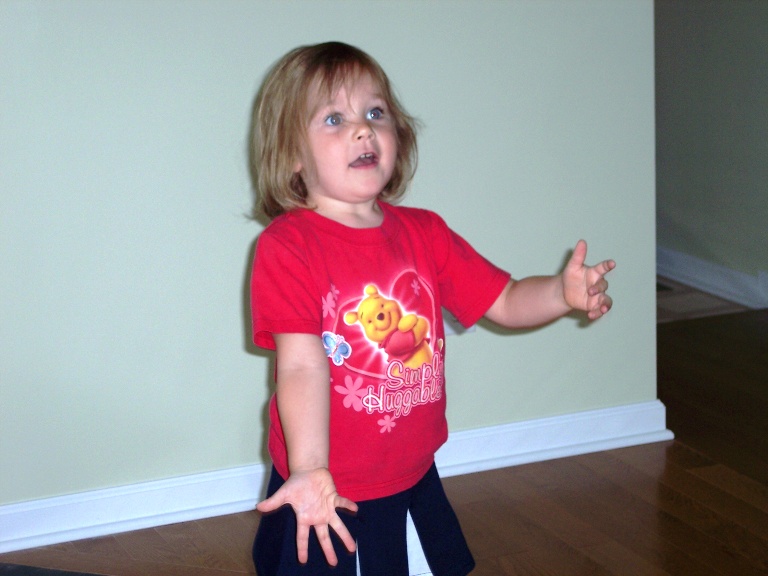
As for the picture with this post, it looks like my granddaughter might be saying, “Okay, now listen to this.” I’m sure I was OK with listening to her story.
Do you like reading about the origin of some of our popular expressions? Do you ever read a historical story and come across a word that sounds out of its time?
Comments 20
I enjoyed reading your informative article about the word, OK? I am glad to know it is a correct word and found the history of how it began to be fascinating. Thank you for all the time and work you put into this research and also the information about the graph for other words.
Author
So glad you enjoyed finding out more than OK, LaVerne. I enjoy delving into word origins and found this especially interesting since I’m always a little leery about letting my characters say okay in my historical stories. I always wonder if it’s really OK for the time period. I think definitely my Shaker sisters and brethren probably didn’t say okay or OK. 🙂
This ended up in my spam folder, which is not OK! LOL ….On a sidenote, I thought for a while that LOL was “lots of laughs” not sure where I got that idea from, but I like your thought that it should stand for “lots of love.” Thanks for the interesting information. 🙂
Author
Definitely, that isn’t OK, Hope, but it happens. Internet mail can be iffy.
LOL is lots of laughs, isn’t it? And ROTFL is rolling on the floor laughing for when something is really funny, but somehow I always doubt the person is really rolling on the floor. I sometimes wonder if the person is even laughing when they write LOL. Maybe smiling. 🙂 And yes, I’m smiling. I promise.
This was a fun, interesting post. I have noticed in reading some historical books, a modern expression written into it that I just know was not in use at that time.
Author
Glad you enjoyed my OK post, Connie. I enjoy checked out words and trying to figure out why they came into general use. All writers have to think about what was said or done in the particular time frame of their stories.
Thank you for the historical background on the word OK. I did not realize it was the most understood word in the WORLD.
I must mention that for several years now the word LIKE is used excessively and annoys me – but that’s me. To hear people talk and say one or two words followed by like is very confusing, at best. Sorry but had to mention and I guess my view is OK.
Have a good day with lots of smiles. And just maybe, you smiled at my note.
Author
I know what you mean, Loretta, like that sometimes bothers me too. 🙂 I do have to watch using like incorrectly in my writing. It’s so easy to use like when actually you should as if or as though or sometimes just change the sentences around altogether. We do use “like” very often in our conversations. It sometimes becomes a substitute for an “um” or “uh” type of word when we have to hesitate to come up with what we want to say.
I do like learning the backgrounds of words! I do wonder how many words we use today would have been used in the past. Some I know were, just not as freely or meaning what they do today. I caught a sentence in an old movie the other day (right before I changed channels) and thought that back during the time when the movie was supposed to be taking place, they probably didn’t use the language used in the movie!
Author
That’s something writers need to avoid when they can, Trudy, because something like that pulls a reader (or watcher) right out of the story and we don’t want to do that.
You’re right too that the meaning of words changes and adjusts as the years go by.
When I saw the title, I assumed you had some fun facts about Oklahoma. LOL! It’s interesting to read about the origins of certain expressions. Sometimes, I don’t believe them, though. Yes, I have read words or phrases that wouldn’t have been used in the time period of the story. Not often but sometimes.
Author
I guess it’s good to not believe everything we come across on the internet, Lee. As my father used to tell me, that paper would lay still and let somebody write anything on it. I think that might be even more true with the internet and a keyboard. But we can also do more checking of the truth of this or that.
And I don’t know that much about Oklahoma, but it might be fun to learn.
OK, Ann, a fun, informative, nicely crafted, interesting read.
Well done, and much superior to okay,
Write On!!
Author
You’re so kind, Chris. Thanks for the encouragement you give me and to all those you are around. To be an encourager is such a good gift.
I enjoyed reading about the word okay. Wishing you a better than okay day
Author
Thanks, Sharon. I did have a better than okay day today. A lot of words ending in “ay” there. lol. Hope your week is better than okay too.
I pray that you have more than an okay day. I pray your day is filled with many blessings and is a super okay day.
Author
Love this, Sharon. Thank you for your prayers for me to have an okay day. It was probably a better than okay day since it was full of sunshine and I got to take a hike with friends to one of my favorite places on the farm. On top of that, Frankie was a good dog and walked with us. 🙂
Fascinating history! I do indeed enjoy reading about the history of words. And yes, I’ve sometimes I wondered if a character (both in books and movies) are using a word that’s out of their time period. But if I look it up, I usually find out it was in fact used.
Thanks for the interesting history of OK!
Have a great week Ann 🙂
Author
I try not to throw in words that aren’t in use for whatever historical time I’m setting my story in, Lavon, but we all mess up at times. I have had my editors catch things before it makes it into print, but sometimes mistakes get past us even after multiple readings. On the internet now you can find a graph with many words that show when they were in popular use. Very helpful.